

Your pool looks fine at first, then the pH keeps drifting, the water turns cloudy, or chlorine stops working the way it should. So the real question is: what does alkalinity do in a pool, and why does it affect everything else?
The truth is, alkalinity helps keep pH steady. When it gets too low or too high, your pool becomes harder to balance.
In this guide, you’ll learn what alkalinity means, why it matters, and how to test, raise, or lower it the right way.
Key Takeaways
- Alkalinity keeps pool water stable by helping prevent fast pH swings.
- pH shows the current water condition, while alkalinity helps keep that number steady.
- The ideal pool alkalinity range is 80–120 ppm for most pools.
- Low alkalinity can cause pH swings, irritation, and possible damage. High alkalinity can cause cloudy water, scaling, and hard-to-adjust pH.
- Rain, acid use, baking soda overuse, refilling water, and overcorrecting chemicals can push alkalinity too low or too high.
- The safest fix is simple: test, adjust slowly, circulate, and retest before adding more chemicals.
What Is Alkalinity in a Pool?
Alkalinity in a pool is the water’s ability to keep pH stable.
That means it helps stop your pool water from becoming too acidic or too basic too quickly. If pH is the number you check, alkalinity is what helps keep that number from jumping around.
For most pools, the ideal total alkalinity range is 80 to 120 ppm. When it stays in that range, your pool is easier to balance, chlorine works better, and the water is less likely to turn cloudy or irritating.Simple rule: pH shows where your water is now, and alkalinity helps keep it steady.
What Does Alkalinity Do in a Pool?
Alkalinity helps keep your pool water stable.
Its main job is to buffer pH, which means it helps stop pH from swinging up and down too fast.
That matters because once pH starts moving all over the place, everything else gets harder too. Your chlorine may not work the way you expect, the water can get uncomfortable, and balancing the pool turns into a constant fight.
So in real-life terms, alkalinity helps your pool:
- keep pH more stable
- make chlorine work more effectively
- reduce sudden water chemistry problems
- make the water easier to manage overall
That is why alkalinity is not just another test-strip number.
It is one of the things that helps the rest of your pool chemistry stay under control.
If alkalinity is in the right range, your pool is usually easier to balance.
If it is off, you often start seeing other problems show up.
What Happens if Pool Alkalinity Is Too Low or Too High?
If pool alkalinity is off, water balance gets harder fast:
- Too low: pH swings quickly, water gets more aggressive, and irritation or damage risk goes up.
- Too high: pH is harder to lower, water can turn cloudy, scaling may build up, and chlorine may work less effectively.
📖 You May Also Like This “Swimming Pool” Article: How To Get Rid of Algae In Your Pool
What Should Pool Alkalinity Be?
For most pools, total alkalinity should be 80 to 120 ppm (parts per million). That is the standard target range most pool owners use.
That range gives your pool enough buffering to keep pH more stable without making the water too hard to adjust. When alkalinity stays in that zone, balancing the rest of your water is usually much easier.
Here is the simple way to read it:
- Below 80 ppm: alkalinity is low
- 80 to 120 ppm: alkalinity is in a good range for most pools
- Above 120 ppm: alkalinity is high
Some pools may run a little differently depending on the sanitizer system or setup, but 80 to 120 ppm is the general answer to “what should pool alkalinity be?”
So if you test your water and want a quick benchmark, that is the number to remember:
Keep pool alkalinity between 80 and 120 ppm.
How to Test Alkalinity in a Pool
There is more than one way to test pool alkalinity.
That is why this gets confusing fast.
You watch one video, and they use drops. Then you read something else, and they use strips. So now you are wondering which one you are actually supposed to follow.
The good news is, the main methods are simple.
Common Ways to Test Pool Alkalinity
Most pool owners use one of these methods:
- Test strips
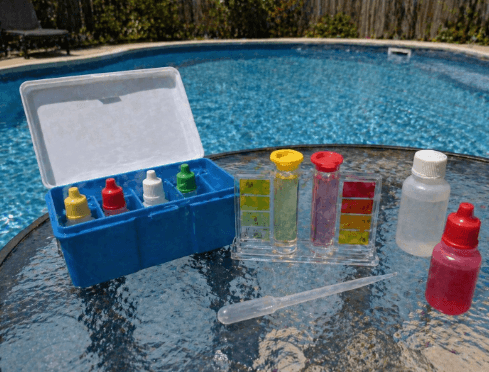
- Liquid test kits
- Pool store water testing
Test strips are quick.
Pool store testing is easy if you want someone else to check it.
But if you want to test it yourself at home and get a more exact reading, a liquid test kit is one of the most common methods.
So let’s go with that one.
Easy Way to Test Pool Alkalinity With a Liquid Test Kit
If you are using a liquid kit like a Taylor test kit, here is the simple process:
- Fill the test tube to the 25 mL line with pool water.
- Add 2 drops of R-0007.
Swirl the tube to mix. - Add 5 drops of R-0008.
Swirl again.
The sample should turn green. - Add R-0009 one drop at a time.
Swirl after each drop and keep counting. - Stop when the color changes from green to red.
- Multiply the number of drops by 10.
That gives you your total alkalinity reading.
Simple Example
If the water turns red after 10 drops of R-0009:
10 × 10 = 100
So your pool alkalinity is 100 ppm.
What This Tells You
Once you have the number, you can compare it to the normal pool range and see whether your alkalinity is too low, too high, or right where it should be.
The main thing is to stay consistent.
Use the same method each time, follow the same steps, and do not rush the drop count. That is how you get a reading you can actually trust.
What Causes High or Low Alkalinity in a Pool?
Pool alkalinity usually changes because something pushes the water chemistry out of balance.
Sometimes it drops after rain, acid use, refill water, or repeated pH-lowering treatments. Other times, it rises because of too much alkalinity increaser, baking soda, high-alkalinity fill water, or overcorrecting after a low reading.
H3: What Causes Low Alkalinity?
Low alkalinity usually happens when the water becomes too acidic.
Common causes include:
- Heavy rain
- Too much acid
- Frequent pH-lowering chemicals
- Splash-out and refilling
- Poor water balance over time
H3: What Causes High Alkalinity?
High alkalinity usually happens when the pool gets too much alkaline material.
Common causes include:
- Too much alkalinity increaser
- Baking soda overuse
- High-alkalinity fill water
- Overcorrecting after a low test result
- Unbalanced water that was not fixed properly
Simple rule: low alkalinity usually comes from acid or water dilution, and high alkalinity usually comes from too much alkaline product or high-alkalinity source water.
How to Balance Alkalinity in a Pool
To balance alkalinity in a pool, start by testing the water first.
For most pools, the ideal range is 80 to 120 ppm. If your reading is below that, you need to raise alkalinity. If it is above that, you need to lower the alkalinity.
Follow this simple order:
- Test the water
- Check if alkalinity is low or high
- Add the right product in a controlled amount
- Let the pool circulate
- Retest before adding more
Don’t try to fix the number all at once. Big corrections can push pH or alkalinity too far the other way.
Simple rule: test first, adjust slowly, circulate, then retest before making another change.
How to Lower Alkalinity in a Pool
If your pool alkalinity is high, the fix is usually to bring it down slowly, not all at once.
That part matters.
A lot of people see a high reading, add too much chemical, and then end up fighting low pH right after that.
The better way is to lower total alkalinity in steps.
First, test the water and confirm that alkalinity is actually high. For most pools, anything above the normal range means you need to bring it down. Once you know that, the basic process is simple:
- Test your total alkalinity and pH
- Add the right acid in a small amount
- Let the water circulate
- Retest before adding more
That is the safest way to lower alkalinity in a pool.
If you are wondering how to reduce pool alkalinity, how to bring alkalinity down in pool water, or what to do if alkalinity is high in pool water, the answer is the same:
Use the right acid, go slowly, and keep retesting.
What to Use to Lower Pool Alkalinity
The most common product for lowering pool alkalinity is muriatic acid. Some pool owners also use dry acid. The right amount depends on:
- pool size
- current alkalinity
- current pH
- acid strength
Do not guess. Use the product label or a pool calculator and start with a controlled dose.
How to Lower Alkalinity Without Affecting pH
You usually cannot lower alkalinity without affecting pH too. In most cases, both move together.
What you can do is lower alkalinity carefully so pH does not crash:
- add acid slowly
- let the water circulate
- retest before adjusting again
So no, you cannot fully separate the two, but you can manage the change.
How to Lower Both pH and Alkalinity
If both pH and alkalinity are high, muriatic acid can help bring both down.
The safe way is:
- add a measured amount
- let the pool circulate
- test again
- adjust only if needed
Do not try to fix both with one huge correction. That is usually when pool water balance starts going sideways.
How to Lower Alkalinity in a Saltwater Pool
The process is mostly the same in a saltwater pool. If alkalinity is high, you still lower it with acid and retesting.
Just be more careful because saltwater pools often already have pH drift issues:
- adjust slowly
- avoid overcorrecting
- keep checking pH and alkalinity
That is the safest way to lower it.
📖 You May Also Like This “Swimming Pool” Article: How to Maintain an Above-Ground Pool?
How to Raise Alkalinity in a Pool
If your pool alkalinity is low, you need to bring it up slowly.
That is the fix.
Low alkalinity usually means your pH is more likely to swing around, which makes the pool harder to manage. So if you are trying to raise alkalinity in a pool, the goal is to get total alkalinity back into the normal range without overdoing it.
The basic process is simple:
- Test your pool water first
- Confirm alkalinity is low
- Add the right alkalinity-raising product
- Let the water circulate
- Retest before adding more
That is the safest way to increase pool alkalinity.
If you dump in too much at once, you can push the water too far the other way and create a new problem.
What to Use to Raise Pool Alkalinity
Use sodium bicarbonate, which is basically baking soda. Most products sold as alkalinity increaser use it for the same job. The exact amount depends on your pool size and current reading, so check the product label or a pool calculator before adding anything.
How to Raise Alkalinity Without Affecting pH
You usually cannot raise alkalinity without affecting pH at all. But baking soda is the usual choice because it raises alkalinity more than pH. So if alkalinity is low and pH is only slightly off, this is normally the safest and most controlled way to adjust it.
How to Raise Both pH and Alkalinity
If both pH and alkalinity are low, soda ash is often the better option because it raises pH more strongly while also helping lift alkalinity. This is different from baking soda, which mainly focuses on alkalinity. Test first so you know which problem you are actually fixing.
Frequently Asked Questions
Does Baking Soda Lower Alkalinity in a Pool?
No. Baking soda raises pool alkalinity, not lowers it. It is commonly used when total alkalinity is too low and the water chemistry keeps shifting.
How to Raise Pool pH Without Raising Alkalinity
Use soda ash in small amounts. It raises pH more than alkalinity, so it is usually the better choice when pH is low but alkalinity is acceptable.